Showing posts with label professional development. Show all posts

Monday, July 14, 2025

Join me! Trauma-Informed Care in the Library starts October 13

 Trauma-Informed Care: An Introduction for Libraries starts October 13!

Sign up by September 29 for a 10% discount.

I'm happy to announce that I will be running Trauma-Informed Care: An Introduction for Libraries through UW-Madison iSchool again this Fall. 

Like my past, well-reviewed courses, this course is designed to have an extremely reasonable workload and will be a mix of reflection, action, and tips you can use right away. The class is asynchronous, which means we won't be meeting live and you can engage with each week's content when you can. Each week there will be one or two discussion questions. There will be final project that will consist of anything that will help you going forward (a presentation to your board, a letter to your director, a blue print, something else? It's up to you!).

As always with my courses, you're welcome to download all the material to share among others in your library, so I hope you will see this as a good investment. Trauma-Informed Care: An Introduction for Libraries is steeped in my lived experience and so may be different from other training you may have gotten about these concepts.

This course about Trauma-Informed Care has been developed with trauma-informed care in mind in its structure. 
NOTE: This course has been well-reviewed by students who have lived experience in trauma. While I do have some tips that work for me peppered in the content, this course is not a therapy support group and I am not a medical professional. This course can give you some insight into what might be going on with your brain/central nervous system right now, but it is not a cure for your stress. I say this not to be mean but to manage expectations. If you are looking for more things like mindfulness practices, I'd like to suggest you look into activities related to dialectical behavioral therapy. It covers mindfulness as well as interpersonal effectiveness, distress tolerance, and emotional regulation.

Ready to register? Sign up here. 
Want to read more about my take on trauma-informed care? Click here to check out the "trauma" tag.

Monday, August 2, 2021

Join Me: Trauma-Informed Care in Libraries Starts Sept 13

 WE GOT A NEW KITTEN


An orange manx kitten sitting on a lap in from of a laptop computer

This is Hacksaw. Stubbins (19) and Larry (11) are still around; Caleb and I just figured it was good timing. Caleb has always wanted an orange manx!

Okay, so now I got that out of the way:

Trauma-Informed Care: An Introduction for Libraries starts September 13!

Sign up by August 30 for a 10% discount.

Like my past, well-reviewed courses, this course is designed to have an extremely reasonable workload and will be a mix of reflection, action, and tips you can use right away. The class is asynchronous, which means we won't be meeting live and you can engage with each week's content when you can. Each week there will be one or two discussion questions. There will be final project that will consist of anything that will help you going forward (a presentation to your board, a letter to your director, a blue print, something else? It's up to you!).

As always with my courses, you're welcome to download all the material to share among others in your library, so I hope you will see this as a good investment. Trauma-Informed Care: An Introduction for Libraries is steeped in my lived experience and so may be different from other training you may have gotten about these concepts.

NOTE: This course has been well-reviewed by students who have lived experience in trauma. While I do have some tips that work for me peppered in the content, this course is not a therapy support group and I am not a medical professional. This course can give you some insight into what might be going on with your brain/central nervous system right now, but it is not a cure for your stress. I say this not to be mean but to manage expectations. If you are looking for more things like mindfulness practices, I'd like to suggest you look into activities related to dialectical behavioral therapy. It covers mindfulness as well as interpersonal effectiveness, distress tolerance, and emotional regulation.

Ready to register? Sign up here. Last time my roster and the waitlist filled quickly!
Want to read more about my take on trauma-informed care? Click here to check out the "trauma" tag.

Wednesday, September 9, 2020

Join me! Trauma-Informed Care: An Introduction for Libraries

UPDATE 9/25/2020: The class is now full! Here goes nothing...

Trauma-Informed Care: An Introduction for Libraries, Oct 5-Nov 15 through UW-Madison iSchool.

 So. Things are interesting, to say the least.

A cat sitting next to a computer, watching the screen
For instance, Larry attends Zoom meetings.

When I last taught "Trauma-Informed Care: An Introduction for Libraries," one of my main objectives was to build empathy for people with backgrounds in trauma through sharing real-life experiences as myself, a person with a brain rewired to expect stress due to trauma. The course was approached with the assumption that there would be a mix of people who would see themselves in the content, people who had some familiarity with the content, and people who possibly needed some convincing that trauma isn't just some buzzword or excuse.

Well, times have changed since *checks post date* last September. My April 30 webinar on trauma responses during a pandemic has been viewed over THREE THOUSAND times. Only like 5 of those were my parents (Twenty, tops). Every day there's new evidence of a population whose brains are overflowing with stress and are acting on ill-planned, counter-intuitive, and counterproductive attempts at self-preservation (to be clear, I'm talking about people who ignore reasonable health guidelines and/or are violent about their need for a haircut, for instance; and not people protesting police brutality). Amid this backdrop public-facing service workers are being met with vitriol for trying to keep themselves and the community safe.

The need for a commitment to trauma-informed principles is, I'd say, pretty clear.

My course on this topic is not the do-all-end-all in healing the world, but it can help you and your colleagues approach work in a way that is helpful for everyone (including yourselves).

Topics I'll cover include:

Wednesday, July 1, 2020

Oregon City Public Library: The Disability Community in the Library

Bryce note: Long time, I know. I hope to catch y'all up at some point. I hope you're hanging in there. Black Lives Matter. Trans Women are Women. Healthcare is a Right. Access is Love.

This summer, I'm running my course "The Disability Community in the Library" through the UW-SLIS iSchool. If you want more information on what that would entail, here's a post I wrote  about what to expect. Register here to join me July 13-August 23!

This time, I thought I'd turn over my course announcement post to Jennifer Giovanetti at Oregon City Library, who has done A TON for the disability community since taking my course in the Fall of 2018.

OR library staff: if you're interested in this course, please look forward to an upcoming free professional development opportunity with the State Library of Oregon. 

And now, handing it over to Jen:


Oregon City Public Library: The Disability Community in the Library
B.A.M (Because Accessibility Matters)


The Oregon City Public Library is dedicated to serving its whole community as equitably and inclusively as possible. Our mission is to empower every Youth, Adult and Senior in our service area through:


  • Innovative and varied resources and programs
  • Responsive, well trained and personable staff
  • Connections to other community resources and events
  • Inclusive, accessible services to all
  • Welcoming spaces to gather and build community

To this end the library has made sincere efforts to ensure that we are serving our whole community including those that are often most marginalized. When library staff noticed that there seemed to be a significant community of adults with disabilities that visited the library, we knew that we wanted to be more intentional about reaching out and serving this part of our library community. We also knew that the best way to do this was to start by educating ourselves about how to best serve this community. This is where Bryce’s class “The Disability Community in the Public Library” came in. After taking this class through the University of Wisconsin, Library staff member Jennifer Giovanetti, began making community connections and developing the B.A.M. (Because Accessibility Matters) program for the Oregon City Public Library to help better serve people with disabilities in the community. Below are some of the things that the Oregon City Library has implemented specifically with our disability community in mind:

  • Universal Design Building Considerations: Since our building was fairly recently renovated and an addition was added in 2016, ADA requirements and Universal Design considerations were implemented as part of the building process. The Oregon City library building, as a whole, is highly accessible and all staff are encouraged to keep aware of any building accessibility or safety issues and report them to management or the disability community liaison (ie. Jen).
    • Some recent additions have been: Automatic bathroom doors, PAC accessibility station, and on-going evaluation of building accessibility.
  • B.A.M Advisory Council: The formation of an advisory committee was key to learning (from the Disability Community itself) how the library could better serve its community members. The B.A.M. Advisory Council is comprised of members of Local Disability organizations, providers and caregivers who with serve people with disabilities, library Board member, staff, and people with disabilities from the local community.
    • Council Mission: The mission of the B.A.M (Because Accessibility Matters) Advisory Council for People with Disabilities will be to serve as a resource to the Oregon City Library addressing accessibility issues, equal rights, removing barriers and promoting opportunities and programs for individuals with disabilities. What we envision is a community group where everyone understands the importance of equal participation and full inclusion of all citizens and is committed to making the Oregon City Library a more accessible place to visit and enjoy for people living with disabilities. 
  • BAM Programming: We started with our highly popular Art Lab program. This was a program that had been designed for Kids and Families, but one that we knew the disability community had been attending and really enjoying. With this in mind, we decided to make an adult version designed especially for Adults with Disabilities and to have the program open to everyone! Starting with something we knew the community already enjoyed helped with the early success of the B.A.M. programming. Other programming ideas grew out of suggestions made by Advisory Council members and BAM program attendees. Below are the on-going B.A.M. programs that the library offers. Of course, much of this is now cancelled/on-hold until the Library re-opens but, we will be starting a new B.A.M. virtual program in June!
  • B.A.M. Art Lab: Monthly Art Class https://www.orcity.org/library/bam-art-lab
  • B.A.M. Lego Lab: Monthly open LEGO studio https://www.orcity.org/library/bam-lego-lab
  • B.A.M. Academy: Monthly series of classes on topics of interest to the disability community (ASL, Emergency Preparedness, Self Determination, Container Gardening, etc.) https://www.orcity.org/library/bam-academy
  • B.A.M. Make-it Together (coming in June!): Maker program using Creative Bug 
  • On-going Education & Advocacy!

Wednesday, March 25, 2020

WTF Is Happening to Your Brain and What You Can Do About It

There's been something I've been thinking about a lot lately but haven't really had the energy to talk about it in any comprehensive way.

I still don't think I'm going to, because investing energy where it needs to go is incredibly important right now. But I will say this:

Visiting this blog, right here, right now, I am allowing you the space to admit and accept that what we're going through is a stressful and potentially traumatizing situation.

People are different. Two people can experience the exact same thing and one can emerge traumatized and the other unscathed.

One thing that might help right now is knowing what might be going on with your brain and central nervous system. The following is something I shared yesterday with friends and family. It's based on the training I received from Trauma-Informed Oregon, which led to me to create a unique introductory course in Trauma-Informed Care that is library-specific. It's not a lot but I hope it helps.


Thursday, December 19, 2019

Why "What Happened to You?" Isn't Trauma-informed

I just finished up my first run of my Trauma-Informed Care: An Introduction for Libraries course.

I hope to run it again next year, but something came up that I felt I should clear up.

There are a lot of different training opportunities lately coming at trauma in the library at different angles.

Quite a few of them start attempting to shift thinking about trauma with the notion that trauma-informed care "seeks to shift the clinical perspective from 'what’s wrong with you' to 'what happened to you'". I can't pinpoint the origin of this quote, but it's been used by such respected organizations as SAMHSA.

This phrase, quite deliberately, does not appear in any of my training materials. That's because I don't believe it's true.

title text in black on a blue and green background


At its most basic, I can understand what this is trying to do: make people who have not experienced trauma that has reshaped their brains start to blame circumstance rather than the people themselves when they have a frustrating interaction. Apparently, wondering what happened to someone is supposed to build empathy so we can act more compassionately.

I humbly submit that thinking this way can have the opposite impact, and instead can inspire pity and possibly resentment. I also contend that asking this question isn't trauma-informed, and is potentially harmful. It also assumes that library staff do not have backgrounds in trauma, which is not universally true.

To demonstrate how this framing might be problematic: here's how a person whose brain has been rewired to expect stress might answer these questions, speaking from experience:

Monday, September 16, 2019

New Course this Fall! Trauma-Informed Care: An Introduction For Libraries

As long-time readers may recall, I've been interested in and studying topics related to trauma since I first learned about the Adverse Childhood Experiences study in 2013.  I've written a lot related to trauma since, and to be quite honest my research has transformed the way I approach my work, as well as my relationships to other people and the world in general. In April 2018, I was chosen by Trauma-Informed Oregon to be trained as a community trainer, and have developed and delivered library-specific training to local library staff, which has been well-received.


So I'm so pleased to announce that I will be running the course:
Trauma-Informed Care: An Introduction for Libraries through UW-SLIS Continuing Education, November 4-December 15, 2019! Register before October 20 for a 10% discount!

Like my past, well-reviewed courses, this course is designed to have an extremely reasonable workload and will be a mix of reflection, action, and tips you can use right away. The class is asynchronous, which means we won't be meeting live and you can engage with each week's content when you can. Each week there will be one or two discussion questions. There will be final project that will consist of anything that will help you going forward (a presentation to your board, a letter to your director, a blue print, something else? It's up to you!).

As always with my courses, you're welcome to download all the material to share among others in your library, so I hope you will see this as a good investment.

I've said on Twitter previously that preparing for this course has made my Disability Community in the Library course feel like Sunday brunch. Like that course, Trauma-Informed Care: An Introduction for Libraries is steeped in my lived experience and so may be different from other training you may have gotten about these concepts.

Here's some of the topics we'll cover:

Wednesday, July 18, 2018

Symposium on the Future of Libraries 2019: A Youth Services Opportunity!

Do you have ideas about the future of youth services? Five years in the future will be here in no time. How about 20?

I've been honored to represent the youth services perspective on the Center for the Future of Libraries Advisory Group the past few years. The Center is a great resource for tracking library trends and sharing future-focused stories through the weekly "Read for Later" newsletter. The Advisory Group's main duties so far have been to review and make recommendations for the Center for the Future of Libraries Fellowship and the Symposium on the Future of Libraries. The Symposium has quickly become a popular offering at the Midwinter Meetings.

A lined background with a red stamp that says, "Due 8/15/18." 
In black text: "Symposium on the Future of Libraries: A YS Opportunity!"


As you know, the Midwinter Meeting is where the Youth Media Awards are announced, which makes it a great space for more youth-specific sessions. This Midwinter's last-minute "Storytime Deep Dive" in the Uncommons was an attempt to fill this need by ALSC member Melissa Depper.

As I said about the the Center for the Future of Libraries Fellowship earlier this year (I mean it double this time):

"I'd love to see a ton of Youth Services submissions. I really feel like there are so many great conversations happening about even the nature of youth services itself, but implementation can be tough when you're running 15 programs a week/managing tours for your whole district/on the desk several hours a week/yelling 'walk please' every 20 minutes/getting Child Germ Flu/constantly planning either Summer Reading or Battle of the Books/ etc etc etc. Or maybe you're facing a rough time and buzzing along and could use a new project to sink your teeth into.

Youth Services IS the future of libraries; we're literally shaping family library legacies and creating lifelong library users and supporters, everyday. But we hardly get the time or support to really consider what that even means. We see it in the courses that are offered, the conference proposals that get accepted, the Storytime Underground questions that get asked again and again: we're looking for quick tips for right now, and that's what we're getting.

And that's great, and it can work.

We ALSO deserve the space, the time, and the support to really consider what youth services actually means, and what our future could look like"


SO: I want to see your proposals for the Symposium in 2019! What ideas are floating around in your head that you want to shake out? Have a presentation in mind, or a discussion you want to see had? The proposal application is live now! Submit your youth-focused proposal by August 15th (not that there's anything else going on for youth services folks right now...).  I know it's all in the throes of SRP,  but I'd love for anyone who has the bandwidth to consider this opportunity.

Thursday, July 12, 2018

Rerun This Fall! The Disability Community in the Library: The Class


I am so happy to announce that this Fall I will be teaching the online course, "The Disability Community in the Library" with the University of Wisconsin-Madison iSchool Continuing Education program! The course will run November 5-December 16, 2018. Register by October 22, 2018 for a 10% discount!

Unsure if this course is for you? Need some help justifying this course to your admin? Read on for more information!

Monday, June 18, 2018

I Have the Mind of an Infant: Mental Age Theory in Libraries

NOTE: If you're new here, welcome! When I write about accessibility, you will find that I use the terms "people with disabilities", "PWD", "the disability community", and "disabled people" interchangeably. This is something I deliberately do to challenge our institutional insistence on "person-first language."


I have this thing due to my cerebral palsy where the muscles in my right hand constantly want to be clenched in a fist. This runs the spectrum from annoying, since it distracts people, to frustrating, because if I’m holding something in my left hand I’m basically immobilized, to incredibly painful. All of my shoulder muscles are nearly constantly tense. Add to this the practice of mirroring; which is where my right hand just really wants to do anything my left hand does due to my mixed-up-rewired Frankenstein of a brain. This results in things like having to ice down my hand after work if I’m writing all day by hand, my right hand deciding that WE TOTALLY NEED TO CLENCH A TIGHTER FIST THIS IS A LOT OF WRITING WE’RE DOING. Standardized tests were a nightmare.

“This thing” is actually a leftover from the Moro reflex, a reflex useful to infants to cling to a parent for survival. It looks like this should go away by the time a child is 6 months old. I’m not big on developmental timelines, since there can be a lot of parental anxiety about that, but I’m thinking 35 is a safe age to say this shouldn’t be happening.

My brain is developmentally disabled, and my body performs in a way that mimics a baby. So, I have the mind of an infant.

Thursday, July 27, 2017

The Disability Community in the Library: The Class

A cartoon cat in a space helmet with a key, emerging from a fancy door with a galaxy pattern behind it.
(Accessibility series logo by Chris at On a Roll Designs)
(who also wrote this amazing post)

A year ago, after hearing about the massacre at Sagamihara  I felt a lot of silence from, like, everyone, but also specifically from my online library communities. A lot of feelings I've had in libraries since I began came to a very abrupt head.

I decided that the hurt I felt was powerful enough to identify myself plainly as the disability killjoy I've always been so scared of being.

Never feeling "disabled enough" to identify as disabled, and not abled enough to shake a person's hand, I fought my entire life to hold onto the illusion  of a modicum of abled privilege that passing gets me; only to live through experiences that reinforced, again and again, how little society regards me once it finds out I tricked it and ~SURPRISE~ I'm not the "normal" person you thought I was and HERE I AM, IN YOUR SPACE. OOPS. (oh, and also how little it regards PWD in general, usually while "passing").

No more of that. After a summer of near constant grief I realized I had no choice, as someone with privilege/power both socially and professionally, but to talk about my disability as openly as I could and amplify the existing voices of the disability community within the world of libraries. I was new, and learning, and I'm still far from calling myself an activist, but it was all I could think of to do.

Thursday, December 29, 2016

Iron Fist: The Class PLUS Programming for School-Agers

HEY EVERYONE.

(This post is ridiculously late, I know. Look out for a post sometime in the New Year about what I've been up to this fiscal year! I really can't wait to share)

Looking to reconsider your space and programming in the New Year with your kid patrons in mind?

Looking for a resource that might save you some money that you don't have for a design consultant?

OR have you just recently fallen down the rabbit hole of my Iron Fist posts and want to sink your teeth into behavior management at your library?

Well you're IN LUCK: I will be running the course "Child Development, Library Space, and Behavior" January 23-March 3, 2017. It's an asynchronous class with a very doable work load (2 discussion questions a week; a culminating project of your choosing; and you're done) with tips you can use right away.

This course is designed with the student in mind: content to digest, questions to help you reflect and synthesize with classmates; and hopefully, a frame of reference that will stick with you as you continue to make changes in your library. I am here for you to get as much out of this class as you can, and there are a few different ways you can engage to make the class the most meaningful it can be for you.


Ready to register? Click this link to get more information. Register by January 9 to get 10% off!

Can't make it? That's okay.  I wanted to also share with you a couple of videos I put together in the past year. They're both only one take, and are pretty long, and I apologize there are no captions or subtitles. From now on, I will make sure to retain my transcripts for further accessible sharing:


2nd and 3rd grade programming from Bryce Kozla on Vimeo.
This video was done right after my "Top Five Places to Hide and Cry in Your Library", I care way less than in previous videos I've made about whether your see my CP-hand or not.


Special Programs and No-School Days from Bryce Kozla on Vimeo.
This video was done soon after my move to Oregon, amid watching lots of WWE promos and the reality show "Legends House", and I think it shows. I'm loud. I point a lot. Like, way more than normal. I might as well say "Listen here, Mean Gene." My accent is still pretty bad in this one. NOTE TO SELF: Even though it looks good here, never get that haircut again. EVEN THOUGH it looks good here.

What professional development resources are you digging lately?

Tuesday, July 12, 2016

Top 5 Places to Hide and Cry at Your Library During Summer Reading (plus bonus links)

You didn't think I could make it through the entire summer just letting other people motivate everyone at WCCLS, did you? Well, I still kinda am. Back before the promised flurry of SRP was punched in the gut by mass shootings and overt injustices, I made a little *attempting to be funny* video about crying in the library.

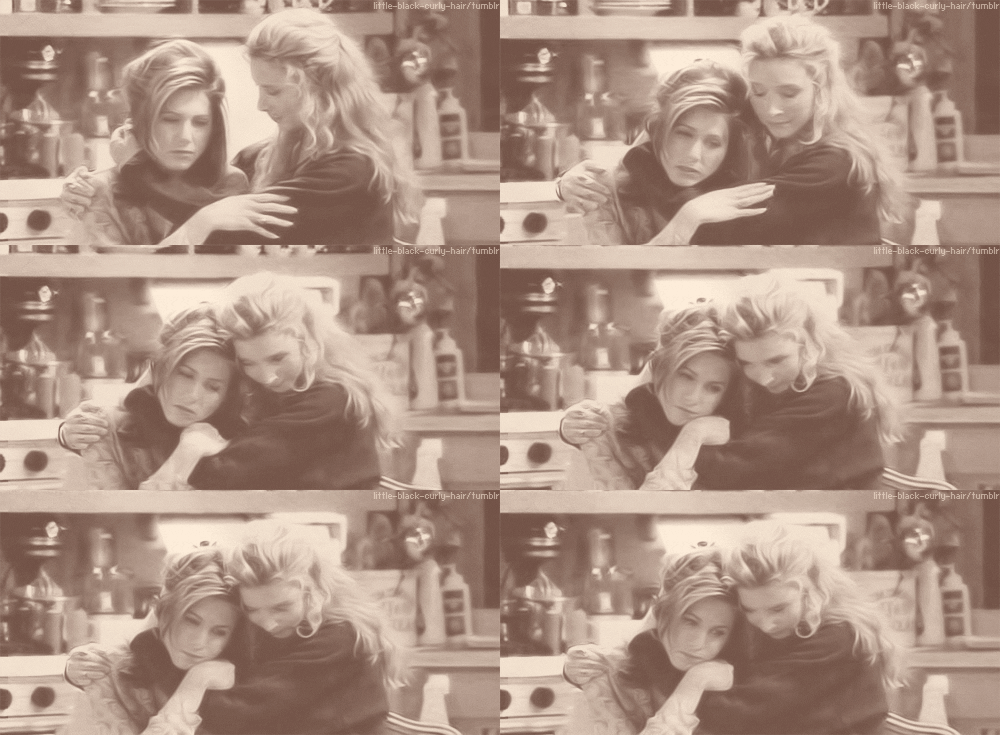
Rachel and Phoebe from F.R.I.E.N.D.S. share a comforting hug.
It's first-take and there's no title cards or props or anything. I always intended to redo it, but I'm unsure I could bring the same levity to this video now:


Thursday, May 5, 2016

Awesome New-to-Me Blogs

I'm celebrating 5 years of this blog, albeit a little late (even though I sincerely thought that my blog's birthday was tomorrow. I swear).

I really can't tell you how much your following my blog means to me. I've lately been revisiting some of my older posts, and how much has changed around here has quite frankly been ridiculous. Thanks, reader, for hanging around! And thanks to everyone who creates their own corners of the web to share what works for them. Putting yourself out there isn't the easiest thing to do, and I appreciate the hell outta you for it.

Last year, when I actually remembered my blog's birthday, I shared my favorite new-to-me blogs. I thought I would do the same this year. Last year's post focused mainly on programming blogs, and this year I've widened my librarianing scope a bit. Here's a snapshot of my new favorites:

Tuesday, December 15, 2015

This Week in Professional Development: Dec 15, 2015

There have been so many great free opportunities for professional development popping up lately! Some can be viewed now; some are to sign up for now and engage with later.

As I've said before, I am so fortunate that I'm in a position where connecting library professionals to resources that can help with their everyday workflow is a valued part of my job. Like the variety of libraries you readers are from, our member libraries vary widely in size, staffing, structure, culture, and community. Free webinars and other resources that can be viewed at one's own pace can benefit everyone at  some angle or another. Isn't the Internet great?!


Here are a few of the things I've been sharing and signing up for lately. Entertaining, thought-provoking, and/or overall awesome, these will keep your mind chugging into the New Year and looking forward to what we can make with youth services in 2016:

Sunday, November 15, 2015

The Center for the Future of Libraries: A YS Opportunity

You may or may not have heard the announcement yesterday that there will be a Center for the Future of Libraries Advisory Group. Oh yeah, and I'm on it. I KNOW. I KNOW. You may be wondering how in the world I, of all people, was asked to be a part of this in the first place, and why in the world I would actually accept. Didn't I just write two months ago about how much of a "library futurist"-averse pearl clutcher I was? What is even happening right now? So I thought I'd shed a little light on that for you.

Christopher Lloyd wearing a shiny suit and a metal contraction on his head.
This is a scene from "Back to the Future" (possibly part 2

Wednesday, October 28, 2015

Early Literacy Advocacy for Elected Officials (with Links to Research)

Last month I was tasked with creating two Powerpoints on early literacy to present to key stakeholders in our community. One was presented to a local governing board, and was given by the Director of the cooperative, the Outreach and Training Manager, and myself.
Child in a suit ("Kid President") standing in front of a school bus.
White text reads, "What are you teaching the world?"

I was pretty excited about this challenge after my first year on the AASL/ALSC/YALSA Interdivisional Committee on School/Public Library Collaboration with Chair Jenna Nemec-Loise of Everyday Advocacy fame.  I approached this with “sound bites they can use” in mind. I also thought about what was “in it for them” as far as early literacy was concerned. An additional opportunity was that, while many of the attendees had been presented with a “libraries and early literacy” talk before, it had been nine years. They needed a refresher, and we had a lot of updates for them—in service and research!

When thinking about “what’s in it for them”, here are a few implied benefits I threaded through the presentation:
1.       You, the governing body, are an educated group.
2.       Early literacy creates educated people who will vote fellow educated people into office.
3.       Early literacy in libraries will keep you or people like you in office.
4.       Profit. (Did you know the return on investment for a community with an early literacy focus is upwards of 16%??? okay maybe you did but your local elected officials probably need that info ASAP).
With that in mind, here are a few sound bites you can use in a future presentation to your governing body:

Friday, October 16, 2015

Iron Fist:the Class II

HEY EVERYONE.
Didn't get a chance to take my continuing education course "Child Development, Library Space, and Behavior" last Spring? 

Have you been regretting it forever as your drown in a sea of disruptive children and your own tears?

Have stumbled on my Iron Fist posts since and would like to learn more about behavior management?

Or are you just looking to take a class about stuff in libraries that you literally won't find anywhere else?

WELL YOU'RE IN LUCK because I'm so excited to announce that Iron Fist: the Class is happening AGAIN March 21-April 29, 2016. Click here to get more information and to register.  Register by March 6 and get 10% off!

Need to convince yourself or the Powers That Be that this class is worth your funds/time? Here's a ridiculously stellar endorsement of this course by Rebecca McCorkindale, who I've dubbed The Librarian Who Saved SRP 2015. 

Here are a few more details if you're on the fence:

Wednesday, September 30, 2015

This Week in Professional Development

There have been a few different fantastic ways I've dug my teeth into youth services this week, and I wanted to make sure to share them all! I place quality professional development in high regard; you can find people talking about all kinds of things everywhere-- but people who know their stuff so intimately that they can be entertaining AND amazingly informative? That's rare. AND, all these professional development opportunities are available free to you.

I was going back and forth as to whether create a curated post like this, but then I was extra-inspired by "Lifting One Another Up" by Jessica at Letters to a Young Librarian. I am so fortunate to be in a position where support for other library professionals, connecting them with resources and PD opportunities, is a valued part of my job. I want to make sure to share the love for those of you who aren't lucky enough to have a Me emailing you every week :)

I find that online professional development is a great way to inspire conversations: share these opportunities, watch them when you have time, and start an email thread about them!