Showing posts with label reluctant readers. Show all posts

Saturday, August 23, 2014

I Survived the Shark Attacks of 1916!

When my dad got his BA back in the 70s,
he was probably imagining that one day
he'd have a child who'd have to
free-hand a large shark.

This Spring, Sarah at YA Librarian Tales and me both had the same idea for a summer program: playing into the wild success of the I Survived series by Lauren Tarshis at our libraries! We had a discussion on Twitter about it that many librarians joined, including the kid-culture-programming maven Angie at Fat Girl Reading. The conundrum: Which book could I feature that meets this criteria: 1) is exciting, and  2) will not bum out everyone attending, especially the adults.

The three that were definitely out for me right away were The Attacks on September 11, 2001, Hurricane Katrina, 2005, and The Battle of Gettysburg, 1863. After a pretty rousing discussion on Twitter, Sarah and I came to the same decision: to tackle The Shark Attacks of 1916. If anything, my decision was dependent on 2 factors here: 1) sharks are cool, and it is super-interesting that they were once thought to be as docile as a bunny rabbit; and 2) the death count was relatively low, so the chances that someone in attendance would say that a family member died in these incidents was slim, nationally.

Monday, August 4, 2014

PUFFIN Library Lab: Sasquatch Escape!

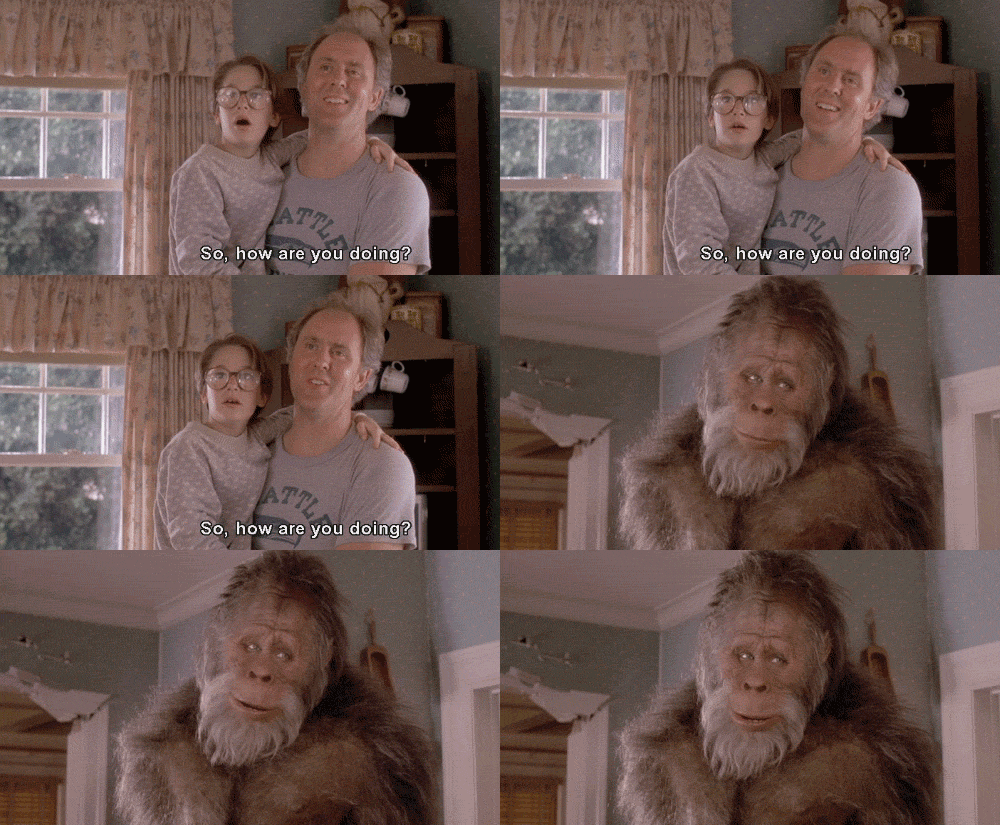
Basically one of my favorite movies of all time.
This summer, we decided to work WITH at least one of the many groups that visit our library each week to help make the experience more positive and delay/prevent teacher burn-out. One local group was known for coming into the library for one hour, then bringing in a second group for another hour, sometimes with the same teachers. Needless to say, eventually during the summer the kids would run out of favorite books to read, and teachers would get sick of helping their students make good choices.

To fill a pretty big need the size of everyone's sanity, P.U.F.F.IN Library Lab (Pop Up Free Fun IN the Library) was born. One program done twice every Tuesday (one for each group that visited), the topic of which announced to the public day-of over Facebook. And damn, did it work out well!

Marge held two PUFFIN labs in June, while I took July. My first program was inspired by Ariel's Monster Party. My rendition of a monster party was based on the book Imaginary Veterinary #1: The Sasquatch Escape by Suzanne Selfors.

As you might remember, I'm kinda into cryptozoology, so I'll basically talk about it whenever I get a chance.


Thursday, April 10, 2014

"K-5 Programming": Differentiating in the Library

This week I had a program where I picked the incorrect book. It was a good book, and good for the topic, and a perfect read-aloud for 8-12 year-old kids.
...Problem was, the day of the program, 4-8 year-old kids showed up. I still "read" the book, skimming pages while following the story; but I left the program disappointed in myself. Why hadn't I prepared for this? Why didn't I just skip the book when I saw who was there? 

I'm kind of glad this came up, because another Iron Fist post has been rattling around in my head, this time about helping kids navigate your programming for success. Truly, the following post is probably step #1 in Traditional Programming Child Management: is your program developmentally appropriate? This is really important to think about now that we're all trying STE(a)M at our libraries. I'm not saying that toddlers can't love learning about the weather or that fifth graders can't love sensory activities; but: how are these ideas presented? Are you explaining clouds in a tangible way that toddlers can connect to their world? Are you talking to fifth graders about the weird things their senses do every day without their knowledge to screw with their heads so they're interested? If they're bored out of their skulls, kids will let you know by acting out. Chaos or disinterest in your program is not their fault, it's yours.

I don't say that to be harsh, I promise. I say that to empower us all: their interest in your program is under your control. 

As I thought about my book of choice, and how disappointed in myself I was, I realized that my programming is influenced by education in a way that I never realized before: differentiating instruction.

Friday, February 7, 2014

Robots vs. Aliens!: Second Grade Outreach

As I've mentioned before, this year we've piloted in Grade School Menu. While I'm currently immersed in Hella Busy No Sleep, I want to make sure I don't get behind on documenting my programming and giving you (and future me) School Tools 4 Days. Luckily enough I just recently wrote out the script for the Second Grade Outreach: Robots vs. Aliens!

Robots vs. Aliens works for 2 reasons: 1) everyone has an opinion on this debate and 2) the kids decide who wins. I patterned the idea after the Shark vs. Train Story Action Pod I made, but fleshed it out into a 30-45 min program

(I feel the need to stress that if you're going to try elementary outreach, in order to get teacher buy-in you're going to have to be able to promise 30 min door-to-door. That way you can be in and out in that magical time period between lunch and math, or during lunch and recess, or after Special Areas but before the bell, when the teacher actually has the time to do a fun activity. If you happen to be scheduled on a Friday with no spelling test, however, for instance, you may be able to stretch it out to 45. Have a craft or game ready if you get that extra time.)

Here's how Robots vs. Aliens! works:

Tuesday, December 17, 2013

Hey. Read: An Unsolicited Rant and a New Year’s Resolution


Note: this post is about the problem I personally have with aliteracy; and if you are currently aliterate, steps you can take to change that, if you'd like. If you or someone you know struggles with direct or indirect effects of illiteracy (functional or not), there are places that can help. One of my favorites is the website for the Florida Literacy Coalition, which is full of resources on the subject.  

I’ve heard and read about proud non-readers before, but my social media feeds lately have been full of people who say things like, “So glad this became a movie because I don’t read” and “if anyone gets me an E-Reader for Christmas I’m throwing it away” and various other ways to inform the world that this person dislikes written communication. People who have the means and opportunity to read, and yet proudly say that they don't.  Not like I actually care, but I originally wrote this post at 4 AM on a Friday morning because I couldn’t sleep because of People Like You.

I’m here to tell you: it’s most definitely not your fault that the word “reading” gets you so apathetic. Chances are you, like me, were told outright that you needed to take standardized tests because if you were sick that day the class wouldn't get enough money. Or maybe you went to a school where bodies in the seats weren't considered currency, but regardless your literacy was treated as a means to an end, rather than the gift to yourself that it is.

You were wronged; it's okay to be mad about it. But reading has so many personal benefits and the only person who is missing out by not reading is you.

I once was like you. It’s true. Me. The librarian and educator who literally went to school for reading, twice, and once to obtain a reading-related job. I went to undergrad for English because I wanted to make sure I didn't drop out, and I enjoyed reading books. By the time I graduated with honors in 2004, I HATED READING BOOKS. Freaking hated it. Though I still believed in the importance of reading (which is why I went back to school to get my literacy development Master’s degree) I personally did not pick up a book I hadn't read before for leisure between the years of 2004-2010. Reading felt like a chore, and I couldn't fully enjoy stories because I got hung up with stuff like “word choice”. My biggest pet peeve when reading is still when an author rediscovers a word and then uses it three times in one chapter. It took me awhile, but I got over it in favor of trying to really lose myself in a story.

Wednesday, January 23, 2013

Ninjago Library Party

Source (seriously, you have to get these books)
At long last, we ran our no-school Ninjago party. To be honest, the total prep time for this program was 3 hours, but it was extremely high-yield at 95 attendees. That is seriously more than I've seen in my time at this library for a program at our library that didn't have a guest or hired performer.
Thanks to the extra prep time, I was prepared. And I'm going to write it out for you all, and link to some resources I found helpful, so that your prep time (and my future prep time; I will be doing this again) will be considerably less than that for the same quality program.

Sunday, January 6, 2013

The Think-Aloud Librarian

Source
Over the weekend, I helped an 8 year old girl find a "Jack and Annie book." I led her to the Magic Treehouse books, talking the whole time: "Oh yeah! The Magic Treehouse books. I know exactly where those are. They are in our Chapter Book section, under O. The author's last name is Osbourne. So here's books by authors who start with N.... Okay, O! Here we go, Osbourne. Right here."

Sound familiar?
You're a Think-Aloud Librarian.

Why Do We Do This? 
It sounds like we're talking to ourselves, right?
In the education world, we call it the "think-aloud": a little tidbit that helps students follow your train of thought or reasoning; or, in a student-directed lesson, help you understand the student's train of thought or reasoning. In either instance, it's a chance an opportunity for learning.

Friday, January 4, 2013

Connecting to Kid Culture

When I was teaching second grade, all the kids liked everything I liked: our collective favorite book was Lafcadio: the Lion Who Shot Back; our collective favorite dinosaur was the parasaurolophus; our collective favorite show was Between the Lions. These are kids who had to be issued pencils before each activity because they demonstrated they would hurt each other, but I'd mention Uncle Shelby and they'd all want to hear whatever weird story about him I made up getting ready that morning. Truth is, everything my class liked was everything I had liked as a kid.

Thursday, November 8, 2012

Readability Measures and Libraries: An Unsolicited Rant

Yesterday I got an e-mail from a friend, for whom I had run long-distance reader's advisory. She was looking for a historical fiction book for her 4th grader to write a book report. Her fourth grader is an avid reader and so I knew I could have fun with it. I gave her about ten titles, from Gordon Korman's Titanic series to Dead End in Norvelt by Jack Gantos.

She got back to me and said that based on their AR established book levels, and since he tested at a 6th grade level on his readability test, he actually is not allowed to choose any of the suggestions I gave for his book report. Including two Newbery award winning contemporary classics; one of which was Bud, Not Buddy, which should probably be read by all 4th grade boys everywhere. The aforementioned Gantos title even has a copy housed in the teen section of our library. But no matter; its book level comes in at a lowly 5.9.

Tuesday, November 6, 2012

Diary of a Wednesday Kid: Make a Comic Like...

The first three Wednesdays in October (the fourth being during my conference committee duties) I ran a new program. It wasn't the most well attended program ever (6-10 kids each time), nor was it the most inspired program I ever did. But:
1) It attracted 3-5 graders
2) I got good feedback from those who attended
3) It took literally 15 minutes to develop and set up every week.

SO, here's what happened: