I just finished up my first run of my Trauma-Informed Care: An Introduction for Libraries course.
I hope to run it again next year, but something came up that I felt I should clear up.
There are a lot of different training opportunities lately coming at trauma in the library at different angles.
Quite a few of them start attempting to shift thinking about trauma with the notion that trauma-informed care "seeks to shift the clinical perspective from 'what’s wrong with you' to 'what happened to you'". I can't pinpoint the origin of this quote, but it's been used by such respected organizations as SAMHSA.
This phrase, quite deliberately, does not appear in any of my training materials. That's because I don't believe it's true.
At its most basic, I can understand what this is trying to do: make people who have not experienced trauma that has reshaped their brains start to blame circumstance rather than the people themselves when they have a frustrating interaction. Apparently, wondering what happened to someone is supposed to build empathy so we can act more compassionately.
I humbly submit that thinking this way can have the opposite impact, and instead can inspire pity and possibly resentment. I also contend that asking this question isn't trauma-informed, and is potentially harmful. It also assumes that library staff do not have backgrounds in trauma, which is not universally true.
To demonstrate how this framing might be problematic: here's how a person whose brain has been rewired to expect stress might answer these questions, speaking from experience:
Showing posts with label librarianing. Show all posts
Thursday, December 19, 2019
Sunday, March 31, 2019
Investing Energy: Staying on Top of Things
My best laid plans the past few years have always seemed to hit snags. For instance: this is my first real blogpost since my blog address change. BDP officially closed on December 31. I had intended to write a heartfelt send-up for the readers who have been around since the beginning. My plans were thwarted, however, as I had to work on investing energy in a large-scale way as I worked through the following things in the past 6 months:
-A car accident involving a man-hole cover flying at my car soon after my 36th birthday (as if my feelings about my birthday aren't complicated enough, the Final Destination-ness of this event stuck with me longer than I care to admit).
-My spouse's 16-year-old cat, Stubbins, nearly dying three days before Christmas (Caleb stayed home last minute to care for him). We've decided to not pursue any further intervention care.
-My parked car being involved in a second accident, this time with a U-Haul on New Years Day. It was nearly totaled, which meant we would spend another year with one car between us; which has become increasingly untenable. The auto body shop was able to find a way to keep the cost just low enough for us to keep it, which I am so grateful for.
Add to this my day and weekend work: At my day job, I was trained as a trainer with Trauma-Informed Oregon and I worked on extensive learning modules based on trauma-informed care (keep an eye out for an online course coming soon that will NOT use these modules but will address related topics); and in my "free" time I created presentations and ran a course on the Disability Community in the library. Usually, I'm able to enjoy vastly different work between my day job and my side stuff. At one point a few months ago, I had just finished writing about historical trauma and institutional oppression; the next day I walked to the coffee shop and opened up my laptop to a slide that just said: "Disabled People are Burdens."
Yeah, it's been fun.
Through all this I'm thinking about stuff I've put in place in order to mitigate particularly stressful situations and stay on top of things. It's really a huge deal for me; and even though I don't have everything under control at all times, I thought I'd share some things that have helped:
-Got my meds right: yes, again. It's a process.
-Have one notebook where EVERYTHING lives: I first got this idea from Shawn Brommer, who presented on her organizational style at the 2015 ILEAD Wisconsin workshop. One thing I've definitely borrowed from her style is writing down things I've accomplished that didn't make my to-do list but I accomplished anyway. My notebook has become such a mainstay in my my office that my boss and two of my coworkers also carry them around everywhere.
-Mark emails on my to-do list: and I don't cross them off until I hit send. Emails can sometimes be easy things to do, though I have a tendency to write them and forget to send them until later. Meds help, but marking them with a little box on the side of my to-do list can alert me to do things I can do to keep things going. If I don't have much time at my desk one day, it's often more important to get emails out in order to keep projects moving than trying to work on a larger project.
-Question why I'm putting something off: I recently have been reading more about procrastination as it's related to anxiety, and it really makes a lot of sense to me. If I'm feeling particularly willful about a task, I do my best to reflect on why that is, and engage in a short de-stress exercise in my toolkit, and it's usually enough to get over it and get started. Way more often than not, interestingly enough, the anxiety is left over from past toxic work environments; I can acknowledge that my anxiety about a task is valid, but is not useful in a work environment in which I feel relatively safe. Reaching out to coworkers to help me remember this has been especially helpful through change.
-Install web tools to increase focus: random web usage when I'm putting stuff off has been common for me, particularly anymore on the weekends. When I'm having a hard time reeling in my work-related anxiety, I actually find it soothing (though COMPLETELY UNPRODUCTIVE, to be fair) to Google the same things over and over again. At one point several years ago, my anxiety was particularly about my place in the world outside of my workplace, which I assumed (irrationally, I know) I would die at before I had the opportunity to leave. Consequently, the thing I Googled the most was, like, my own name. My own self-preservation had completely taken over. To disrupt this tendency anymore, I use tools like Block Site. Seeing the block screen is often enough for me to engage in a de-stress activity and rededicate my brain.
-Write things down as a I remember them: As I go through the week, occasionally my mind will wander in a meeting or on non-work time and I remember something that I need to do. I'll either email the idea to myself, or write it in the margins of my notebook with a big star. At the beginning of the next week, all big-starred and emailed items are added to my to-do list.
-Have meeting days and non-meeting days where possible: this is a hugely useful change I'm moving toward thanks to my coworker Katie. I'm sure I'm not alone in that my brain works differently at meetings versus at my desk, and it can be tough to transition if meetings are scattered throughout the week. While scattered meetings are not completely unavoidable, I try to find at least one day every two weeks where there are no meetings scheduled, and rope off that time on my calendar. This is time to dig into large projects and catch up.
Staying on top of things can be overwhelming especially when life goes pear-shaped. But it's been powerful to figure out a system that works for me in a job as varied as the one I've got.
What are some things that help you stay on top of things?
-A car accident involving a man-hole cover flying at my car soon after my 36th birthday (as if my feelings about my birthday aren't complicated enough, the Final Destination-ness of this event stuck with me longer than I care to admit).
-My spouse's 16-year-old cat, Stubbins, nearly dying three days before Christmas (Caleb stayed home last minute to care for him). We've decided to not pursue any further intervention care.
-My parked car being involved in a second accident, this time with a U-Haul on New Years Day. It was nearly totaled, which meant we would spend another year with one car between us; which has become increasingly untenable. The auto body shop was able to find a way to keep the cost just low enough for us to keep it, which I am so grateful for.
Add to this my day and weekend work: At my day job, I was trained as a trainer with Trauma-Informed Oregon and I worked on extensive learning modules based on trauma-informed care (keep an eye out for an online course coming soon that will NOT use these modules but will address related topics); and in my "free" time I created presentations and ran a course on the Disability Community in the library. Usually, I'm able to enjoy vastly different work between my day job and my side stuff. At one point a few months ago, I had just finished writing about historical trauma and institutional oppression; the next day I walked to the coffee shop and opened up my laptop to a slide that just said: "Disabled People are Burdens."
Yeah, it's been fun.
Through all this I'm thinking about stuff I've put in place in order to mitigate particularly stressful situations and stay on top of things. It's really a huge deal for me; and even though I don't have everything under control at all times, I thought I'd share some things that have helped:
-Got my meds right: yes, again. It's a process.
-Have one notebook where EVERYTHING lives: I first got this idea from Shawn Brommer, who presented on her organizational style at the 2015 ILEAD Wisconsin workshop. One thing I've definitely borrowed from her style is writing down things I've accomplished that didn't make my to-do list but I accomplished anyway. My notebook has become such a mainstay in my my office that my boss and two of my coworkers also carry them around everywhere.
-Mark emails on my to-do list: and I don't cross them off until I hit send. Emails can sometimes be easy things to do, though I have a tendency to write them and forget to send them until later. Meds help, but marking them with a little box on the side of my to-do list can alert me to do things I can do to keep things going. If I don't have much time at my desk one day, it's often more important to get emails out in order to keep projects moving than trying to work on a larger project.
-Question why I'm putting something off: I recently have been reading more about procrastination as it's related to anxiety, and it really makes a lot of sense to me. If I'm feeling particularly willful about a task, I do my best to reflect on why that is, and engage in a short de-stress exercise in my toolkit, and it's usually enough to get over it and get started. Way more often than not, interestingly enough, the anxiety is left over from past toxic work environments; I can acknowledge that my anxiety about a task is valid, but is not useful in a work environment in which I feel relatively safe. Reaching out to coworkers to help me remember this has been especially helpful through change.
-Install web tools to increase focus: random web usage when I'm putting stuff off has been common for me, particularly anymore on the weekends. When I'm having a hard time reeling in my work-related anxiety, I actually find it soothing (though COMPLETELY UNPRODUCTIVE, to be fair) to Google the same things over and over again. At one point several years ago, my anxiety was particularly about my place in the world outside of my workplace, which I assumed (irrationally, I know) I would die at before I had the opportunity to leave. Consequently, the thing I Googled the most was, like, my own name. My own self-preservation had completely taken over. To disrupt this tendency anymore, I use tools like Block Site. Seeing the block screen is often enough for me to engage in a de-stress activity and rededicate my brain.
-Write things down as a I remember them: As I go through the week, occasionally my mind will wander in a meeting or on non-work time and I remember something that I need to do. I'll either email the idea to myself, or write it in the margins of my notebook with a big star. At the beginning of the next week, all big-starred and emailed items are added to my to-do list.
-Have meeting days and non-meeting days where possible: this is a hugely useful change I'm moving toward thanks to my coworker Katie. I'm sure I'm not alone in that my brain works differently at meetings versus at my desk, and it can be tough to transition if meetings are scattered throughout the week. While scattered meetings are not completely unavoidable, I try to find at least one day every two weeks where there are no meetings scheduled, and rope off that time on my calendar. This is time to dig into large projects and catch up.
Staying on top of things can be overwhelming especially when life goes pear-shaped. But it's been powerful to figure out a system that works for me in a job as varied as the one I've got.
What are some things that help you stay on top of things?
Thursday, March 24, 2016
What is a Librarian: An Unsolicited Rant
Yesterday I checked my phone in the morning to find that Book Riot posted an article on non-degreed librarians, and how they have value as humans.
As I read it, that’s what this article was about.
I was disappointed, but not surprised, at the number of negative comments that this article received.
I could write here the many arguments I’ve had when this topic comes up and the comment section explodes: about the process to become a brewmaster and how there are people who run breweries or make beer who are NOT brewmasters, technically (they are usually called head brewers). Or I could talk about the one time a child ran me down in a grocery store calling for her “library teacher” and how I said hi to her rather than explaining that my teacher certification lapsed years ago (and even then, I was never certified to teach in THAT state). Or even how people who are nurses for their entire careers have to take an updated test every few years to prove that they can still Be a Nurse Good; so please stop with “librarians are the doctors/para-professionals are the nurses” because last time I checked it was not a universal requirement for even librarians to keep up with certifications (I mean, it may be that April will arrive and I will have spent 5 years in libraries and I will be summoned to engage in a Hunger Games-style competition using only the Dublin Core, so stay tuned). But instead I want to hit a bit closer to home here, parking this officially in Unsolicited Rant territory.
This was not the only thing I saw shared on social media yesterday. Another widely shared link was to a Libraries Transform post. The supporting text, when shared by ALA, that accompanies this post is “Librarians are early literacy experts!” This was shared on Facebook, at the time of this writing, 496 times. That many shares tells me that a lot of librarians agree with it. And before I recognized the funny juxtaposition that inspired this post, I was kinda pissed.
Thursday, March 3, 2016
Healthy Boundaries in Work Relationships: Self Care times a Million
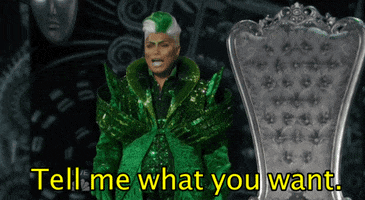
“I’ll be what you want until I can’t be that anymore.”
![]() |
| A person in a sparkly green jacket. Text reads, "Tell me what you want." |
I long ago figured out that this was like my motto in romantic-type relationships before I met my spouse. In December 2005, I had recently recovered from an 8 month relationship (that we ridiculously drug out to over a year) followed closely by a three week relationship. The timetables were different, but the arc of the relationship was painfully the same: Figure out what you want me to be, try to be that, get exhausted being that, force a breakup.
Then I met Caleb. I was tentative at first, not trusting myself. And while that sounds terrible as a romantic comedy plot, it actually helped me create the boundaries I didn’t know I needed for us to get to know each other at a slower pace, and form a more lasting relationship.
I’ve held a few different positions in my 11 professional years, and some working relationships have looked similar to my old romantic habits. The feeling that comes up when I examine any dissatisfying or failed relationships is the feeling of being consumed. And when I have attempted to set boundaries once that feeling starts to happen, there are hurt feelings and broken trust.
And I’ve been doing lots of examining lately, because I’m in the first year of a new job again. And as the old demotivational poster goes:
Monday, August 3, 2015
5 Simple Questions to Inspire Your Service
One of the things I had planned to do from the beginning was try to meet every one of the youth librarians I'll work alongside and tour their space. In the middle of summer reading. I know: I'm already The Worst; it can only go up from here! But truthfully, I have been so fortunate to be welcomed warmly and have scheduled sit-down chats with nearly all of the member youth librarians, with a last few ironing out a time.
I wanted to share the questions I'm asking to see which member librarians I haven't met yet read my blog and will be prepared when I see them. Just kidding. Clearly. I actually wanted to share them because I've found them to produce such a wealth of information and have inspired so many ideas that I think everyone should do this with their own colleagues immediately, whether you've known each other for decades or if you're just starting out; if you're a student or unemployed, you can ask these of your mentors or squirrel them away for when you're a new hire.
Monday, January 5, 2015
I Resolve to Rock in 2015: Mottos to Librarian By
This post is in conjunction with Storytime Underground's Resolve to Rock campaign.
I've written and rewritten this post like 500 times now. I'm torn, because: 1) In 2014, The Profession (what I've come to call the angle of librarianship which is akin to the phrase "The Business" in professional wrestling-- the aspects that help turn entertainment into sport) challenged a lot of people, apparently, including me. Resolutions sound exhausting. 2) I'm not one to normally make resolutions. 3)Actually, I think "resolutions sound exhausting" pretty much sums it up.
And then Brytani wrote a post that gave me feels. And so I thought: okay I'll write a resolution post. And then Arielle wrote a post about not being able to ever actually plan for your life. And seriously, everyone, if anyone knows what she's talking about when it comes to Your Life as a Ride, it's Arielle. So I decided to kind of let both these posts shape mine. Rather than resolutions, I'm going to take lessons I learned in 2014 and turn them into Mottos to Librarian By in 2015. Feel free to use them yourself, and add yours in the comments!
I've written and rewritten this post like 500 times now. I'm torn, because: 1) In 2014, The Profession (what I've come to call the angle of librarianship which is akin to the phrase "The Business" in professional wrestling-- the aspects that help turn entertainment into sport) challenged a lot of people, apparently, including me. Resolutions sound exhausting. 2) I'm not one to normally make resolutions. 3)Actually, I think "resolutions sound exhausting" pretty much sums it up.
And then Brytani wrote a post that gave me feels. And so I thought: okay I'll write a resolution post. And then Arielle wrote a post about not being able to ever actually plan for your life. And seriously, everyone, if anyone knows what she's talking about when it comes to Your Life as a Ride, it's Arielle. So I decided to kind of let both these posts shape mine. Rather than resolutions, I'm going to take lessons I learned in 2014 and turn them into Mottos to Librarian By in 2015. Feel free to use them yourself, and add yours in the comments!
Wednesday, March 21, 2012
Two Keys to Library Field Trips: Time and Bodies
This post is about our Library Stars tour FIELD TRIP ADVENTURE, and can be considered on its own or as a continuation of this post.
Very soon—perhaps alarmingly soon—after your grant has been accepted, it’s time to plan what the tour will actually look like. The schools, with whom you’ll be collaborating, will want to know intricate details about the tour. In the early stages of planning and school collaboration, this may feel excessive; but having your hows/whys down will help solidify teacher buy-in and satiate all worriers.
And with the worriers, you may encounter two of the most worrisome hindrances to tours on the library’s end—Time and Bodies.
Subscribe to:
Posts (Atom)