Thursday, February 16, 2017

Summer Reading Hype videos: Call for Contributors

Quote by Brene Brown written in black on a blue background. Text says:
"You either walk inside your story and own it or you
stand outside your story and hustle through your worthiness"
Source
All right everyone, I know a lot of us are feeling it right now. Doubling down to welcome our patrons, worrying about a bunch of different stuff. Perhaps your compassion fatigue is pretty high and  your regular attempts at self-care aren't working as well as they normally are.

I've got a post brewing that addresses this new normal, but until then, I figured I would put out this call:

Did you enjoy last year's Summer Reading hype videos?
Do you want to contribute to a culture of support in the Youth Services community?
Do you have tips, commiseration, encouragement or just plain humor that you want to share, connecting to others to lift each other up when the going gets tough?

I'm currently in search for volunteers to create a new batch of Summer Reading hype videos!

Thursday, December 29, 2016

Iron Fist: The Class PLUS Programming for School-Agers

HEY EVERYONE.

(This post is ridiculously late, I know. Look out for a post sometime in the New Year about what I've been up to this fiscal year! I really can't wait to share)

Looking to reconsider your space and programming in the New Year with your kid patrons in mind?

Looking for a resource that might save you some money that you don't have for a design consultant?

OR have you just recently fallen down the rabbit hole of my Iron Fist posts and want to sink your teeth into behavior management at your library?

Well you're IN LUCK: I will be running the course "Child Development, Library Space, and Behavior" January 23-March 3, 2017. It's an asynchronous class with a very doable work load (2 discussion questions a week; a culminating project of your choosing; and you're done) with tips you can use right away.

This course is designed with the student in mind: content to digest, questions to help you reflect and synthesize with classmates; and hopefully, a frame of reference that will stick with you as you continue to make changes in your library. I am here for you to get as much out of this class as you can, and there are a few different ways you can engage to make the class the most meaningful it can be for you.


Ready to register? Click this link to get more information. Register by January 9 to get 10% off!

Can't make it? That's okay.  I wanted to also share with you a couple of videos I put together in the past year. They're both only one take, and are pretty long, and I apologize there are no captions or subtitles. From now on, I will make sure to retain my transcripts for further accessible sharing:


2nd and 3rd grade programming from Bryce Kozla on Vimeo.
This video was done right after my "Top Five Places to Hide and Cry in Your Library", I care way less than in previous videos I've made about whether your see my CP-hand or not.


Special Programs and No-School Days from Bryce Kozla on Vimeo.
This video was done soon after my move to Oregon, amid watching lots of WWE promos and the reality show "Legends House", and I think it shows. I'm loud. I point a lot. Like, way more than normal. I might as well say "Listen here, Mean Gene." My accent is still pretty bad in this one. NOTE TO SELF: Even though it looks good here, never get that haircut again. EVEN THOUGH it looks good here.

What professional development resources are you digging lately?

Tuesday, December 20, 2016

"There Goes Your Hero": An Accessibility Series Post

Accessibility series logo

Chris Frantz is the artistic mastermind behind my blog design and the Accessibility Series logo (check out her amazing business, On a Roll Designs). I've known Chris Frantz for 20 years, mostly as an acquaintance; but it wasn't until we reconnected on Facebook that we became closer. I found out over Facebook that she has cerebral palsy, like me-- or, as people with cerebral palsy on the Internet call it, we're both "ceeps"*. When I first thought of the Accessibility Series, the very first post I ever wanted was this one, originally published by her  on her personal website in November 2013.

 “What are you going to call me?”

I looked up, probably from reading celebrity gossip. “What’s that?”

“On the blog,” my husband clarified. “What are you going to call me?”

It was a fair question, and one I’d been posing to myself since I’d decided to start this project. See, in my years on LiveJournal he came to be known as Mr. Beets, a takeoff on my nom de pixels “Bears Eat Beets.” (FACT.) On Facebook I usually refer to him as “my better half,” “mah boo,” and other similarly corny titles. In real life he gets tagged with all sorts of affectionate nicknames, most of ‘em scatological in nature.

His query prompted all sorts of suggestions from both of us, and eventually devolved into us reciting the epic list of David Ryder’s many monikers from Mystery Science Theater 3000 (which tends to happen with more discussions in our house than it probably should HAHA IF THAT'S POSSIBLE).

By the end we still didn’t really have an answer. I couldn’t come up with anything good on my own, either.

I’m going to call him Brandon. Because that’s his name.

Brandon is a lot of things. He’s a dork of the highest order. He’s a pub trivia dream teammate. He’s a sabermetrics devotee. An engineer. A borderline socialist. He’s the owner of an insanely good head of hair and he’s our fat cat’s favorite cuddle buddy. He’s both a mature appreciator of meta humor and a giggly seven-year-old when it comes to fart jokes. For me personally, he’s a lover (as much as I hate that word), a protector, a fan, and a support. He’s a caretaker - I don't just mean he hugs me when I'm down or makes me soup when I’m  sick; my well-being and the fulfillment of just about every basic need is essentially in his hands. Most of all he’s the best best friend - he listens, he makes me laugh harder than anyone else, and he calls me on my shit.

What he is not is a hero. 

Wednesday, December 14, 2016

Let's Talk About the Future at ALA Midwinter


Remember a few weeks ago, when I talked about librarianing is a political act and how some work I had been involved in lately has encouraged me to remain an ALA member for the time being?

Remember how I had my reservations about accepting an appointment to the Center for the Future of Libraries Advisory Group?

Well, I am here to tell you how stoked I am about something that the Center for the Future of Libraries has in store for the ALA Midwinter Meeting this January in Atlanta:

The Symposium on the Future of Libraries.

Yes, I know. But check it out: this Symposium is jam-packed full of meaningful and doable learning experiences and calls to action. Here are a few of the sessions I'm going to drag you to if you're ever in my general vicinity at the Midwinter Meeting... er, may be of interest to you, Reader:

The Future of Librarian Labor
Emily Drabinski, Coordinator of Library Instruction, LIU Brooklyn
Eamon Tewell, Reference and Instruction Librarian, Long Island University, Brooklyn
In an era of unprecedented attacks on teaching and learning in higher education, how can librarians mobilize to advocate for their own wages and working conditions, which can be understood as the learning conditions of students? This session will explore labor issues in academic libraries in the context of a future marked by increasing management control. Participants will explore strategies including union struggle and cross-sector organizing as modes for working against transfers of institutional power from libraries and classrooms to administration. This session will be of interest to academic librarians in both public and private sectors.

Think Universal…To Design Accessible Services for All
Patrice Johnson, Librarian, Chicago Public Library
Pat Herndon, Director, Georgia Library for Accessible Statewide Services at Georgia Public Library Service
Jill Rothstein, Managing Librarian, Andrew Heiskell Braille and Talking Book Library, New York Public Library
The most popular technologies (Apple’s iPhone and iPad) build accessibility into the beginning of their design, creating experiences that are beneficial to all users. When it comes to our own future planning, libraries need to design innovative programs and accessible services that are inclusive of people with disabilities from the first stages of planning. This session will explore insights, strategies, partnerships, and resources that libraries can implement with a focus on serving those with visual and physical disabilities.

Building Civic Engagement with a Civic Lab
Amy Koester, Youth & Family Program Supervisor, Skokie Public Library
Amita Lonial, Learning Experiences Manager, Skokie Public Library
Disappearing local news sources and today’s polarized political landscape mean the library’s role as a space for civic engagement is increasingly important. The Civic Lab at Skokie Public Library is a pop-up library that encourages dialogue and engagement on the issues that affect our community. Featuring all-ages collections and resources on major and emerging issues, including climate change and Black Lives Matter, the flexible, mobile space is used for formal and informal programming for families, teens, and adults. Learn about how this type of pop-up space can invigorate civic discourse and literacy in the library and the community.

Towards A Less Normative Future in Library Services to Children/Teens
Angie Manfredi, Head of Youth Services, Los Alamos County Library System
When we envision the future of libraries, youth services librarians must actively push for de-centralizing Whiteness, particularly in our collection development. This session will help librarians critically evaluate not just the media they purchase for their youth patrons but also the sources that review it. The future of libraries, and of library collections, must reflect the reality of the communities we serve and we, as gatekeepers, need to be advocates for change.

Task Force on Equity, Diversity, and Inclusion Recommendations: An Equitable Future for ALA and the Profession
Leslie Scott, Library Director, Prosper Community Library (Texas)
Melissa Cardenas-Dow
Martin Garnar, Dean, Kraemer Family Library, University of Colorado, Colorado Springs
Lessa Pelayo-Lozada, Young Readers Librarian, Palos Verdes Library District
LaJuan Pringle, Branch Manager, Charlotte Mecklenburg Library
ALA’s Task Force on Equity, Diversity, and Inclusion has developed a plan and strategic actions to build more equity, diversity, and inclusion among our members, the field of librarianship, and our communities. As these recommendations shift to an Implementation Working Group in 2016-2018, we will need to continue the public and honest conversations that help keep these issues at the forefront. Task Force and Working Group members will present the recommendations in the context of the future of the United States and will ask for participation from attendees to help advance our profession to reflect and represent our nation’s ever-increasing diversity. All library workers will benefit from learning how they can contribute to this important work.

21st Century Library Ethics
Sarah Houghton, Director, San Rafael Public Library
As the world goes increasingly digital, the climate surrounding information politics becomes increasingly convoluted. Libraries are caught in the heart of these tangled issues. When was the last time you looked at the ethical statements of our profession? When you sign contracts and revise policies are you keeping those ethics in mind? As you develop programs for your users are you thinking about how to fold in the ethics of freedom of information and privacy? If not, now's a great time to start.

Crafting Successful Youth Civic Engagement in Information Spaces
Chaebong Nam, Postdoctoral Fellow, Department of Government, Harvard University
Danielle Allen, Professor, Department of Government/Graduate School of Education, Director, the Edmond J. Safra Center for Ethics, Harvard University
Libraries are the key information space for young people to engage in a range of connected digital experiences. How can information professionals help young people leverage libraries to craft successful civic engagement—not only physical space but human, organizational, and social resources¬¬? To address this issue, in part, participants will learn of an action-reflection frame for youth participation developed by MacArthur Foundation’s Research Network on Youth Participatory Politics. Then, they can discuss practical steps to infuse the frame into practice. Library professionals who closely work with youth are welcome, especially youth services librarians and school librarians.

...Right?! Right?!
The whole schedule is online here.

If you missed a chance to submit a proposal for Midwinter, never fear! Another Symposium is in the works for Annual.

One more thing:

Interested in exploring a project that will result in a deliverable to help inform the future of libraries? Apply for the Center for the Future of Libraries fellowship. Deadline is January 15, 2017!

Tuesday, December 6, 2016

It's like the Ocean; You Can Learn the Currents: An Accessibility Series Post

Accessibility series logo

Lisa Cohn is a librarian in an urban public library. Her primary focus is genealogy research, but she's worn a variety of hats in her almost 20 years of library service including: interlibrary loan, programming, book displays, publicity and, of course, reference.

"The staff thinks you don’t like them.” The Director had taken me out to lunch to tell me this shortly before she left our urban public library.  Also that she got complaints about me once a month from patrons.  I should be nicer.  I should accept social invitations more often.    She was an introvert and her husband got panic attacks, so she understood, even if her Facebook feed was filled with parties and dinners out and so many friends.   And why was I still working here anyway (after 19 years).  I seem unhappy. Why hadn't I gone for a job where I didn't have to interact with  people so often?  I left that lunch shaking my head.  It took me a while to come around to the idea that just as I don’t always understand how “normal” people can socialize so easily, it must be hard for them to understand what it’s like to live with a Panic Disorder.

 I got my diagnoses from my family doctor in college when we had to cut short a vacation because of my symptoms. I remember the appointment as a series of   questions which I answered all as yes!  I was relieved that he seemed to know what was wrong with me.  I don't remember what the questions were, but they were probably similar to these from Diagnostic and Statistical Manual of Mental Disorders:
-Do you have repeated or unexpected “attacks” during which you suddenly are overcome by intense fear or discomfort for no apparent reason?
-If yes, during an attack did you experience any of these symptoms?
--Pounding heart
--Sweating
--Trembling or shaking
--Shortness of breath
--Choking
--Chest pain
--Nausea or abdominal discomfort
--"Jelly" legs
--Dizziness
--Numbness or tingling sensations
--Chills or hot flushes
-As a result of these attacks have you experienced a fear of places or situations where getting help or escape might be difficult?
-As a result have you felt unable to travel without a companion?
-Have you felt persistent concern about having another attacks?
-Have you changed your behavior to accommodate the attacks?

I was given medication to help me cope and read every book on the topic I could find.   Workdays invariably, even after all these years, bring on some variety of symptoms.  After a while, I've even gotten to the point where dealing with symptoms is my normal.  I must hide it well, although I assume the symptoms manifest on the outside as unhappy, judging from my former boss’s comments. Everyday situations, standard patron interactions, etc, all can be difficult.

 I remember one Wednesday evening when I was helping two teenage boys look for a video. They were young, but still taller than me.  I brought them back into the stacks where we kept the videos they had asked about.  I was trapped between them.  Nothing happened, but I felt as if something was about to.  A flash flood of panic rushing through the stacks to sweep me away.  I made some excuse and fled and had to take my break early to gather myself.  After that, I tried to lead patrons into the stacks while still leaving myself some room to exit should the need arise.

When I first started here, I thought I'd be up to going to a staff holiday party one December. It was a crowded restaurant and service was slow.  The longer we waited, the louder everything seemed to be. Dishes and silverware clattered.  Voices rose and overlapped.  It wasn't long before my panic had risen to a level where I just couldn't stand it anymore.  I don't remember what excuse I gave but I fled for home.   I wasn't relieved to get out of there, but rather disgusted at myself for not even being able to go to a party.  I haven’t gone to many since, although I’ve tried a couple times over the years.
 
A few years ago, I went to  the state library association convention a couple of hours south by car with some fellow librarians.  I went to a few meetings on topics I was interested in and walked around the vendor room.  I was waiting for my colleagues around lunchtime when I started to panic.  I was about 2 hours from home and not there under my own transportation so I was trapped until everyone was done.  This time, however, I managed to successfully remember my coping techniques.  I went outside, took a walk near the shore, and remembered to breathe from the diaphragm.  I took  a Xanax and gave myself permission to just leave the situation for a while and I calmed down.  I haven’t gone to the state meeting since, or many meetings away from the building (thankfully, a lot are being offered as webinars now anyway).

I think some people equate panic attacks with a Panic Disorder and believe if you confront it, it'll go away.  But when it's chronic like this, it's not going to stop because you face your fear.  It's like the ocean.  You can learn the currents.  Know what your triggers are so you can avoid being swept under and drown in waves of fear, but the ocean isn't going to evaporate because you accepted a party invitation or did something you were afraid of.  It doesn't go away. You do have to keep trying though.  It might be easier to look for a job where I didn’t have to go to an occasional meeting or interact with people so much, but I know my world would shrink to the office walls around me. Interacting with a variety of people forces me to daily stretch my emotional muscles so I can keep swimming the ocean of my fears.   I may not have an active social life with lots of parties and dinners out, but I talk to a variety of people every day, with the express purpose of helping them in some small way.

I weigh situations like parties or meetings against my history of being able to deal with them and my current level of emotional balance and energy.  So, after 19 years, when the boss invites me out to an unexpected lunch, I take a Xanax to head off the flood of panic attacks.  I picked a restaurant that is within easy walking distance, not because I was planning to flee the restaurant (this time) but because knowing I could make me able to stay.  I asked the maitre'd  if we could eat in a quieter section.  I sit near the door.    I  know that some people won't understand me just as I sometimes don't understand people who can just go to or throw a party without calculating where it is, how they'll get there, how many people will be there and who.   Just as I have people who understand and accept me for who I am and value the time I can spend with them and forgive me for the times when I just can't.  And those who understand that I'm not anti-social or unhappy, that my Panic Disorder tends to consume a lot of my energy.

Looking for more on accessibility?
Click here for more in the accessibility series.

Click here for a growing digital page of links to more resources.

Click here to read about submitting a post to the Accessibility Series.

Tuesday, November 29, 2016

"A Lot of Librarians Are Spoonies": An Accessibility Series Post

Accessibility series logo
Jessica Schomberg is one of my first collaborators on this blog series, and I'm excited to learn more from them as we explore this topic. 

Jessica is currently serving as Library Services Department Chair at Minnesota State University, Mankato, where their other hats include Media Cataloger and Assessment Coordinator. Jessica tweets as @schomj.

It wasn’t until I read Susan Wendell’s The Rejected Body last year that I started really recognizing and internalizing the idea that I am a person with disabilities. I grew up with Type 1 diabetes, have had thyroid disorders for a few decades, and was recently diagnosed with general anxiety disorder and depression.

When I first joined Twitter (in 2009!), I primarily followed librarians and people with diabetes. I initially lurked during #critlib (critical librarianship) and #dsma (diabetes social media advocacy) chats and followed a lot of people who talked about things that resonated with me. Over time, I began participating in those chats and started to realize that my diabetes and my work life actually do intersect a lot -- and that it’s okay. I also heard about the term spoonie and began interacting with other members of the spoonie community. Through these opportunities, I learned that a lot of librarians are spoonies. And a lot of librarians live with mental illness. Talking with others like me gave me the confidence to seek out support for depression when I needed it.

Sunday, November 13, 2016

Accessibility Series: Definitions and 5 Quick Tips

Accessibility series logo
UPDATE: Welcome, new readers! if you're interested in guest posting, please click here for more information. 


On Saturday, I was honored to present at the Oregon Library Association Children's Services Division fall workshop, as part of an afternoon on diversity. I figured a lot of what I talked about might be a good starting point for this accessibility series! Note: I am very new to this activism and, probably like many of our guest posters, still battling my own internalized ableism. If you see something that is incorrect or needs to be amended or updated, please email me at brycedontplay at gmail dot com. 
Here we go:

Monday, October 31, 2016

The Disability Community in the Library: An Exciting Announcement!

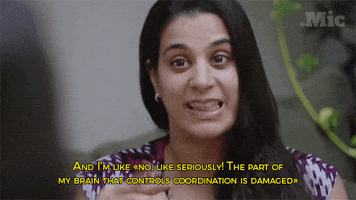
Picture of comedian Maysoon Zayid
Includes quote: "And I'm like, 'No, like seriously! The part of my brain
that controls coordination is damaged!'"
The first time I ever read a children's or YA book with a disabled character I could identify with, I was 29 years old.

Reviews on Goodreads will tell you that this book is horribly written, and loses the plot halfway through, and it’s just terrible and it’s probably weeded from most teen collections even though it was published in 2011. To tell you the truth I don’t even remember much of what it was about except “If Dawson had cerebral palsy” but that was the biggest thing: It was like reading a book about an abled character. Or, maybe, it was reading a book about a character that got abled character treatment: he had interests and passions and a screwed up friend and realistic goals and all of that had nothing to do with having cerebral palsy. He just had it. And lived.

This was (and still is) rare. The closest feeling I can get to my feeling reading this book was the feeling expressed by some women with the release of Ghostbusters 2016: “this is important and cathartic and satisfying and comforting and god why wasn’t it perfect it should have been perfect.” I wished it was better so that more people liked it, so that more books would be written about realistic disabled characters.

Around this time was the first time I actually started talking to other disabled people about disabilities. Specifically, when I was 29, it was people with cerebral palsy about cerebral palsy. People with other disabilities came later: an extended family member of mine has a disability, one that they have had my entire life, and it did not occur to me to talk about the disabled experience with them until Christmas two years ago. I started reading more about myself as a member of the disability community, rather than as a person in a world not created for me and didn’t understand my experience enough to represent me in media.

Tuesday, October 18, 2016

Summer Reading Tic-Tac-Toe: A guest post by Katie Gatten

Poodles dancing in leotards
Katie Gatten is the Branch and Youth Services Administrator for the Mansfield/Richland County Library in Mansfield, OH, located directly between Columbus and Cleveland. There are 75,000 cardholders in their diverse county. For more information on their Summer Library Program, contact Katie a kgatten at mrcpl dot org.

This post will be decorated with GIFs of cute animals dancing because we all need that in our lives right now.

We decided to change up our Summer Library Program this year, having done the same program for many years.  It wasn’t a bad program, but we just wanted to try something fresh.  We had been giving the kids reading records to complete with 7 images to check off that represented 15 minutes of reading time.  When they turned in a completed record they got to pick a prize.  This was the classic Rhode Island Novelty stuff that was cheap quality yet costly, and fell apart soon after the kids received it.  Once the child completed 5 records and visited the library five times, they would also receive a final prize of a new paperback book of their choice.

Tuesday, August 30, 2016

The "Made it Through" Awards

There are a lot of awards in library-land. While they're there to commend brilliant work, it can often make the rest feel like we're not good enough, not shiny enough. And sometimes, it's enough for many library staff just to get through the day.

Ribbons that say, "I put pants on today" and "adulting honorable mention"

I decided we need some acknowledgement of the everyday things that keep our workplaces moving along. And I'm calling them the "Made it Through" awards.

I created these images in Credly, but the logistics of giving them to other people or claiming them was more time than I felt like spending. so I took screen-caps and turned them into .JPGs.  Scroll to the bottom for the direct link to the Google Drive folder, or right-click to save.

Tuesday, July 12, 2016

Top 5 Places to Hide and Cry at Your Library During Summer Reading (plus bonus links)

You didn't think I could make it through the entire summer just letting other people motivate everyone at WCCLS, did you? Well, I still kinda am. Back before the promised flurry of SRP was punched in the gut by mass shootings and overt injustices, I made a little *attempting to be funny* video about crying in the library.

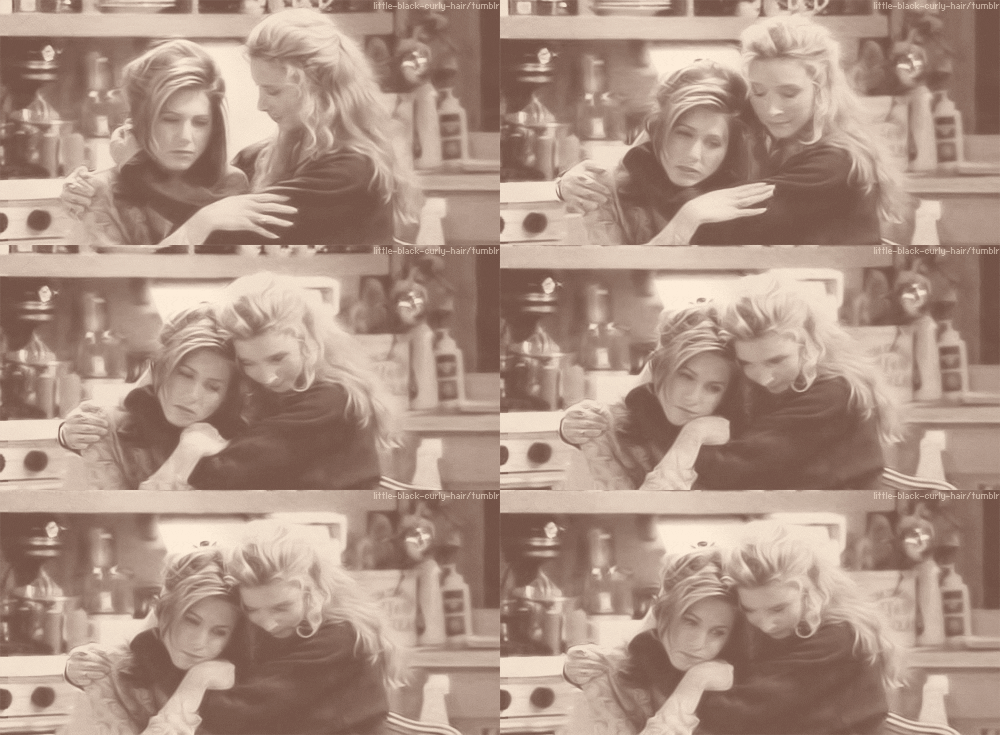
Rachel and Phoebe from F.R.I.E.N.D.S. share a comforting hug.
It's first-take and there's no title cards or props or anything. I always intended to redo it, but I'm unsure I could bring the same levity to this video now: