Showing posts with label PWD. Show all posts

Wednesday, July 1, 2020

Oregon City Public Library: The Disability Community in the Library

Bryce note: Long time, I know. I hope to catch y'all up at some point. I hope you're hanging in there. Black Lives Matter. Trans Women are Women. Healthcare is a Right. Access is Love.

This summer, I'm running my course "The Disability Community in the Library" through the UW-SLIS iSchool. If you want more information on what that would entail, here's a post I wrote  about what to expect. Register here to join me July 13-August 23!

This time, I thought I'd turn over my course announcement post to Jennifer Giovanetti at Oregon City Library, who has done A TON for the disability community since taking my course in the Fall of 2018.

OR library staff: if you're interested in this course, please look forward to an upcoming free professional development opportunity with the State Library of Oregon. 

And now, handing it over to Jen:


Oregon City Public Library: The Disability Community in the Library
B.A.M (Because Accessibility Matters)


The Oregon City Public Library is dedicated to serving its whole community as equitably and inclusively as possible. Our mission is to empower every Youth, Adult and Senior in our service area through:


  • Innovative and varied resources and programs
  • Responsive, well trained and personable staff
  • Connections to other community resources and events
  • Inclusive, accessible services to all
  • Welcoming spaces to gather and build community

To this end the library has made sincere efforts to ensure that we are serving our whole community including those that are often most marginalized. When library staff noticed that there seemed to be a significant community of adults with disabilities that visited the library, we knew that we wanted to be more intentional about reaching out and serving this part of our library community. We also knew that the best way to do this was to start by educating ourselves about how to best serve this community. This is where Bryce’s class “The Disability Community in the Public Library” came in. After taking this class through the University of Wisconsin, Library staff member Jennifer Giovanetti, began making community connections and developing the B.A.M. (Because Accessibility Matters) program for the Oregon City Public Library to help better serve people with disabilities in the community. Below are some of the things that the Oregon City Library has implemented specifically with our disability community in mind:

  • Universal Design Building Considerations: Since our building was fairly recently renovated and an addition was added in 2016, ADA requirements and Universal Design considerations were implemented as part of the building process. The Oregon City library building, as a whole, is highly accessible and all staff are encouraged to keep aware of any building accessibility or safety issues and report them to management or the disability community liaison (ie. Jen).
    • Some recent additions have been: Automatic bathroom doors, PAC accessibility station, and on-going evaluation of building accessibility.
  • B.A.M Advisory Council: The formation of an advisory committee was key to learning (from the Disability Community itself) how the library could better serve its community members. The B.A.M. Advisory Council is comprised of members of Local Disability organizations, providers and caregivers who with serve people with disabilities, library Board member, staff, and people with disabilities from the local community.
    • Council Mission: The mission of the B.A.M (Because Accessibility Matters) Advisory Council for People with Disabilities will be to serve as a resource to the Oregon City Library addressing accessibility issues, equal rights, removing barriers and promoting opportunities and programs for individuals with disabilities. What we envision is a community group where everyone understands the importance of equal participation and full inclusion of all citizens and is committed to making the Oregon City Library a more accessible place to visit and enjoy for people living with disabilities. 
  • BAM Programming: We started with our highly popular Art Lab program. This was a program that had been designed for Kids and Families, but one that we knew the disability community had been attending and really enjoying. With this in mind, we decided to make an adult version designed especially for Adults with Disabilities and to have the program open to everyone! Starting with something we knew the community already enjoyed helped with the early success of the B.A.M. programming. Other programming ideas grew out of suggestions made by Advisory Council members and BAM program attendees. Below are the on-going B.A.M. programs that the library offers. Of course, much of this is now cancelled/on-hold until the Library re-opens but, we will be starting a new B.A.M. virtual program in June!
  • B.A.M. Art Lab: Monthly Art Class https://www.orcity.org/library/bam-art-lab
  • B.A.M. Lego Lab: Monthly open LEGO studio https://www.orcity.org/library/bam-lego-lab
  • B.A.M. Academy: Monthly series of classes on topics of interest to the disability community (ASL, Emergency Preparedness, Self Determination, Container Gardening, etc.) https://www.orcity.org/library/bam-academy
  • B.A.M. Make-it Together (coming in June!): Maker program using Creative Bug 
  • On-going Education & Advocacy!

Wednesday, August 15, 2018

Should I Share This Inspiring Story About Disability? A Checklist

TL;DR: Usually, no.


NOTE: If you're new here, welcome! When I write about accessibility, you will find that I use the terms "people with disabilities", "PWD", "the disability community", and "disabled people" interchangeably. This is something I deliberately do to challenge our institutional insistence on "person-first language."

The other night I was dismayed to see several people I follow on social media sharing, liking, and "loving" the same new viral story about a PWD. These stories are great for the people and their families, when shared personally and on their terms. But then, sometimes the stories are picked up for likes and shares, and go viral  by playing into the abled narrative: disabled people don't just live their life and enjoy new experiences for their own sake; they exist to teach everyone about how grateful we should be to be able to do something they can't.

I was so confused as to why, after so many posts, conversations, and shared links, that people close to me still didn't get it. Didn't think critically about this story and whether they should share it before hitting "share post." Didn't think about the lived experience of PWD before deciding that the person featured existed to teach the world about gratitude. I wondered what I was even doing here. I wrote a FB post about it, then deleted it almost immediately, thinking about the fights I didn't want to have.

I slept on it and decided to write this post instead.

This, of course, is not just about that one post. I've also seen posts across groups and Twitter threads where library staff share their sweet stories to keep us all going-- and some of these happen to specifically mention the fact that the person they were helping was disabled, or "looked" disabled. Occasionally these posts are called out in the comments, to be defended as "I just wanted to share a story." Members in groups tag mods who assert that it's the job of disabled members to educate other members, that everyone is "still learning." (if you're serious about learning, there is a Facebook group-- here-- that exists for PWD to volunteer their time to answer questions). As if Google doesn't exist. As if we're not all information professionals.

So I decided to make checklist about whether or not to share stories about disability you find "inspiring", particularly if you are an abled person.

Friday, June 29, 2018

Investing Energy-What's Working For Me: The News Edition


“When one is engaged in suffering, there is so much more to it than keeping it all together”.
This is a quote from Laura van Dernoot Lipsky, founder of the Trauma Stewardship Institute. She said this in a TEDx talk in 2015 titled “Beyond the Cliff.”

Okay.

So.

There is a lot going on.

I get that it can be hard to focus, and hard to know where our focus is supposed to land. I believe this is by design.

I posted before about investing energy. This summer is similar, since my spouse’s full-time gig fell through and we’re adjusting to another new normal where we work mostly opposite schedules and reconfigure our finances. It’s also a little different, for the above reasons and other more personal ones. But I find myself reflecting more on how to cultivate energy, and how to make more “room in the margins” as Laura van Dernoot Lipsky puts it. (I saw her speak a few months ago and it was transformative. Check out her new book, “The Age of Overwhelm: Strategies for the Long Haul” coming out in July).

These are things that have been working for me. You are welcome to try them. You are welcome to mock me for them. Whatever you want to do, really, but I figured I’d share in case they might help:

Monday, June 18, 2018

I Have the Mind of an Infant: Mental Age Theory in Libraries

NOTE: If you're new here, welcome! When I write about accessibility, you will find that I use the terms "people with disabilities", "PWD", "the disability community", and "disabled people" interchangeably. This is something I deliberately do to challenge our institutional insistence on "person-first language."


I have this thing due to my cerebral palsy where the muscles in my right hand constantly want to be clenched in a fist. This runs the spectrum from annoying, since it distracts people, to frustrating, because if I’m holding something in my left hand I’m basically immobilized, to incredibly painful. All of my shoulder muscles are nearly constantly tense. Add to this the practice of mirroring; which is where my right hand just really wants to do anything my left hand does due to my mixed-up-rewired Frankenstein of a brain. This results in things like having to ice down my hand after work if I’m writing all day by hand, my right hand deciding that WE TOTALLY NEED TO CLENCH A TIGHTER FIST THIS IS A LOT OF WRITING WE’RE DOING. Standardized tests were a nightmare.

“This thing” is actually a leftover from the Moro reflex, a reflex useful to infants to cling to a parent for survival. It looks like this should go away by the time a child is 6 months old. I’m not big on developmental timelines, since there can be a lot of parental anxiety about that, but I’m thinking 35 is a safe age to say this shouldn’t be happening.

My brain is developmentally disabled, and my body performs in a way that mimics a baby. So, I have the mind of an infant.

Sunday, November 13, 2016

Accessibility Series: Definitions and 5 Quick Tips

Accessibility series logo
UPDATE: Welcome, new readers! if you're interested in guest posting, please click here for more information. 


On Saturday, I was honored to present at the Oregon Library Association Children's Services Division fall workshop, as part of an afternoon on diversity. I figured a lot of what I talked about might be a good starting point for this accessibility series! Note: I am very new to this activism and, probably like many of our guest posters, still battling my own internalized ableism. If you see something that is incorrect or needs to be amended or updated, please email me at brycedontplay at gmail dot com. 
Here we go:

Monday, October 31, 2016

The Disability Community in the Library: An Exciting Announcement!

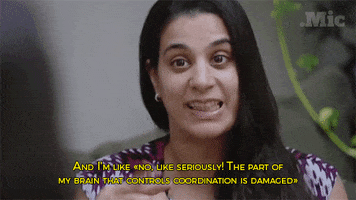
Picture of comedian Maysoon Zayid
Includes quote: "And I'm like, 'No, like seriously! The part of my brain
that controls coordination is damaged!'"
The first time I ever read a children's or YA book with a disabled character I could identify with, I was 29 years old.

Reviews on Goodreads will tell you that this book is horribly written, and loses the plot halfway through, and it’s just terrible and it’s probably weeded from most teen collections even though it was published in 2011. To tell you the truth I don’t even remember much of what it was about except “If Dawson had cerebral palsy” but that was the biggest thing: It was like reading a book about an abled character. Or, maybe, it was reading a book about a character that got abled character treatment: he had interests and passions and a screwed up friend and realistic goals and all of that had nothing to do with having cerebral palsy. He just had it. And lived.

This was (and still is) rare. The closest feeling I can get to my feeling reading this book was the feeling expressed by some women with the release of Ghostbusters 2016: “this is important and cathartic and satisfying and comforting and god why wasn’t it perfect it should have been perfect.” I wished it was better so that more people liked it, so that more books would be written about realistic disabled characters.

Around this time was the first time I actually started talking to other disabled people about disabilities. Specifically, when I was 29, it was people with cerebral palsy about cerebral palsy. People with other disabilities came later: an extended family member of mine has a disability, one that they have had my entire life, and it did not occur to me to talk about the disabled experience with them until Christmas two years ago. I started reading more about myself as a member of the disability community, rather than as a person in a world not created for me and didn’t understand my experience enough to represent me in media.