Tuesday, November 29, 2016

"A Lot of Librarians Are Spoonies": An Accessibility Series Post

Accessibility series logo
Jessica Schomberg is one of my first collaborators on this blog series, and I'm excited to learn more from them as we explore this topic. 

Jessica is currently serving as Library Services Department Chair at Minnesota State University, Mankato, where their other hats include Media Cataloger and Assessment Coordinator. Jessica tweets as @schomj.

It wasn’t until I read Susan Wendell’s The Rejected Body last year that I started really recognizing and internalizing the idea that I am a person with disabilities. I grew up with Type 1 diabetes, have had thyroid disorders for a few decades, and was recently diagnosed with general anxiety disorder and depression.

When I first joined Twitter (in 2009!), I primarily followed librarians and people with diabetes. I initially lurked during #critlib (critical librarianship) and #dsma (diabetes social media advocacy) chats and followed a lot of people who talked about things that resonated with me. Over time, I began participating in those chats and started to realize that my diabetes and my work life actually do intersect a lot -- and that it’s okay. I also heard about the term spoonie and began interacting with other members of the spoonie community. Through these opportunities, I learned that a lot of librarians are spoonies. And a lot of librarians live with mental illness. Talking with others like me gave me the confidence to seek out support for depression when I needed it.

Sunday, November 13, 2016

Accessibility Series: Definitions and 5 Quick Tips

Accessibility series logo
UPDATE: Welcome, new readers! if you're interested in guest posting, please click here for more information. 


On Saturday, I was honored to present at the Oregon Library Association Children's Services Division fall workshop, as part of an afternoon on diversity. I figured a lot of what I talked about might be a good starting point for this accessibility series! Note: I am very new to this activism and, probably like many of our guest posters, still battling my own internalized ableism. If you see something that is incorrect or needs to be amended or updated, please email me at brycedontplay at gmail dot com. 
Here we go:

Monday, October 31, 2016

The Disability Community in the Library: An Exciting Announcement!

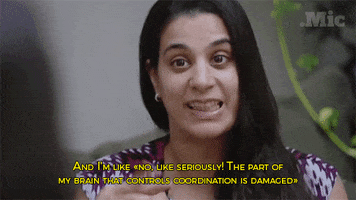
Picture of comedian Maysoon Zayid
Includes quote: "And I'm like, 'No, like seriously! The part of my brain
that controls coordination is damaged!'"
The first time I ever read a children's or YA book with a disabled character I could identify with, I was 29 years old.

Reviews on Goodreads will tell you that this book is horribly written, and loses the plot halfway through, and it’s just terrible and it’s probably weeded from most teen collections even though it was published in 2011. To tell you the truth I don’t even remember much of what it was about except “If Dawson had cerebral palsy” but that was the biggest thing: It was like reading a book about an abled character. Or, maybe, it was reading a book about a character that got abled character treatment: he had interests and passions and a screwed up friend and realistic goals and all of that had nothing to do with having cerebral palsy. He just had it. And lived.

This was (and still is) rare. The closest feeling I can get to my feeling reading this book was the feeling expressed by some women with the release of Ghostbusters 2016: “this is important and cathartic and satisfying and comforting and god why wasn’t it perfect it should have been perfect.” I wished it was better so that more people liked it, so that more books would be written about realistic disabled characters.

Around this time was the first time I actually started talking to other disabled people about disabilities. Specifically, when I was 29, it was people with cerebral palsy about cerebral palsy. People with other disabilities came later: an extended family member of mine has a disability, one that they have had my entire life, and it did not occur to me to talk about the disabled experience with them until Christmas two years ago. I started reading more about myself as a member of the disability community, rather than as a person in a world not created for me and didn’t understand my experience enough to represent me in media.

Tuesday, October 18, 2016

Summer Reading Tic-Tac-Toe: A guest post by Katie Gatten

Poodles dancing in leotards
Katie Gatten is the Branch and Youth Services Administrator for the Mansfield/Richland County Library in Mansfield, OH, located directly between Columbus and Cleveland. There are 75,000 cardholders in their diverse county. For more information on their Summer Library Program, contact Katie a kgatten at mrcpl dot org.

This post will be decorated with GIFs of cute animals dancing because we all need that in our lives right now.

We decided to change up our Summer Library Program this year, having done the same program for many years.  It wasn’t a bad program, but we just wanted to try something fresh.  We had been giving the kids reading records to complete with 7 images to check off that represented 15 minutes of reading time.  When they turned in a completed record they got to pick a prize.  This was the classic Rhode Island Novelty stuff that was cheap quality yet costly, and fell apart soon after the kids received it.  Once the child completed 5 records and visited the library five times, they would also receive a final prize of a new paperback book of their choice.

Tuesday, August 30, 2016

The "Made it Through" Awards

There are a lot of awards in library-land. While they're there to commend brilliant work, it can often make the rest feel like we're not good enough, not shiny enough. And sometimes, it's enough for many library staff just to get through the day.

Ribbons that say, "I put pants on today" and "adulting honorable mention"

I decided we need some acknowledgement of the everyday things that keep our workplaces moving along. And I'm calling them the "Made it Through" awards.

I created these images in Credly, but the logistics of giving them to other people or claiming them was more time than I felt like spending. so I took screen-caps and turned them into .JPGs.  Scroll to the bottom for the direct link to the Google Drive folder, or right-click to save.

Tuesday, July 12, 2016

Top 5 Places to Hide and Cry at Your Library During Summer Reading (plus bonus links)

You didn't think I could make it through the entire summer just letting other people motivate everyone at WCCLS, did you? Well, I still kinda am. Back before the promised flurry of SRP was punched in the gut by mass shootings and overt injustices, I made a little *attempting to be funny* video about crying in the library.

Rachel and Phoebe from F.R.I.E.N.D.S. share a comforting hug.
It's first-take and there's no title cards or props or anything. I always intended to redo it, but I'm unsure I could bring the same levity to this video now:


Thursday, June 30, 2016

The Importance of Deliberate Play Opportunities for School-age Kids and Teens

In the spirit of Summer Reading, this post will be filled with completely unrelated galaxy cats.

I’ve talked about the power of play in relation to early literacy and the Babies Need Words Every Day campaign. Today, I want to talk about the importance of the deliberate use of play with school-age children and adolescents.

When we talk about play and creativity in the library, we often talk about young children. And why not? Play is one of Every Child Ready to Read’s five practices. Once children hit kindergarten, though, we talk about makerspaces. We talk about STEM. Even though these are steeped in self-discovery in the library, the overt goal is to educate. Or, at least, add to our evidence that the library helps children “learn” by the academic definition. And for good reason:  It’s clear that libraries have resonated with stake holders about their role in early literacy education. The next obvious step is to show that we make an academic difference with school-age children. Some libraries do pre- and post-tests to prove Summer Reading helps prevent the Summer Slide. I’ve created outreach with measurable alignment to State Standards.


But it’s important not to lose the very real fact that play has non-academic benefits. If you’ve been following this blog for a while you may notice that even saying this signals a huge shift in my thinking over the past year or so. Down to the deepest parts of my heart and soul, I am an educator who was born out of the public school system and for all its faults I will defend what is considered a public school classroom until at least the end of this sentence, and probably after that. I will give you that it’s not for every single individual; but public education has never been about The Single Individual, anyway.

That’s why I think it may feel so critical to me that I separate the library from its possible academic benefits here.  Play has so many additional benefits, especially for school-age children and adolescents who come from backgrounds in trauma: those who live with food insecurity or transiency, those who live with toxic stress, those who live in volatile or neglectful environments. Those who may not have a space to play. Basically, a lot of the kids and teens who come into our libraries whether we’re aware of it or not.

If we wanted more deliberately center our school-age and teen programming around play in a non-academic way, what could we say to justify it?


Friday, June 10, 2016

Attention Parent Friends:The Case for Summer Reading

Google image search: "Summer". Checks out.
A lot of times, my main audience is library staff, specifically in Youth Services. Sometimes, though, I like to talk to the public in general. This post is inspired by my non-librarian friends all over the country who love to tell me when they’ve connected to their local libraries—and right now I'm getting at least weekly messages that people are signing up for Summer Reading!


PARENTS: Sign yourself and your (possibly still in utero) children up for your local library’s Summer Reading Program!

What is Summer Reading?
Summer Reading is an ongoing drop-in program happening throughout the summer across the United States (and across the northern hemisphere currently, if you want to get technical). Public libraries everywhere encourage children and families to read and engage in enriching literacy- and learning-based activities throughout the summer.  Many programs involve a reading log or game card with which your child or family can track their reading and other activities throughout the summer. At intervals throughout the summer (minutes or books read, or sheets turned in), small prizes may be awarded, sometimes with the possibility of raffles for larger prizes. Many libraries choose to giveaway a book as a final prize or even as a sign up incentive.

Throughout the summer there also fun events to attend. Think parties, carnivals, concerts, programming series with a weekly “summer camp” feel… all at your public library!

Many libraries offer Summer Reading for ages 0-adult; meaning that it starts at age zero (obviously a read-to-me program). Adults can read for prizes and/or glory too!

As with the vast majority of public library programming, funding for Summer Reading comes from general programming funds or fundraising from the Friends of the Library group, so you pay nothing to join!

Why should my family join Summer Reading?

Monday, May 23, 2016

Crafting a Parent Presentation

Today you can find me at the ALSC blog talking about potential partnership opportunities with schools.Since it's written, I figured I'd share here an alternative post on something I do a lot in my job: talking to parents about the library.

Your local PTO or parent group meeting is a great place to reach local families who may not be regular library patrons.  It’s important that we librarians are able to break down the jargon and make the library an accessible community asset, as parent meetings are a great place to make connections with residents who may never have set foot in a library—or had a bad experience, and have since been scared to return.

Here are my four main components to every parent meeting presentation:

Friday, May 20, 2016

Holidays and Libraries: Rethinking Our Programming


UPDATE 11/2019 to address some related comments:
One thing I want to make clear, and may add this to the post, is that it isn't intended to, say, shame a library asst who's been told they'll lose their job if they don't have a Santa program.


Safety =/= comfort, but stay safe.

There are small things we can all do to work toward/into inclusion. It's important that fear of a little pushback doesn't immobilize us. It's important to distinguish feelings of discomfort and literally placing yourself in an unsafe scenario--which can be difficult, especially if you've have a background in trauma. We all need to find our own way forward. These are just some ideas of mine.


This week I was honored to present at the New Jersey Library Association Conference in Atlantic City. I have a few posts mulling around in my head about it, including at least one more really heavy one. For ease of posting something soon, however, I'd like to share my contribution to the panel "Rethinking Holidays & Cultural Celebrations in Libraries" that I presented with the lovely Dr. LaShauna Dean, Assistant Professor of Mental Health and Addiction Counseling at William Paterson University. 

This will probably read harsher than many of my other posts, but understand I am very passionate about the topic of inclusion.

I do not celebrate holidays in the library and do not suggest running holiday programming.

I know how I sound to some of you: I’m no fun, and I don’t like whimsy, and I Scrooge around shushing carolers.

Thursday, May 5, 2016

Awesome New-to-Me Blogs

I'm celebrating 5 years of this blog, albeit a little late (even though I sincerely thought that my blog's birthday was tomorrow. I swear).

I really can't tell you how much your following my blog means to me. I've lately been revisiting some of my older posts, and how much has changed around here has quite frankly been ridiculous. Thanks, reader, for hanging around! And thanks to everyone who creates their own corners of the web to share what works for them. Putting yourself out there isn't the easiest thing to do, and I appreciate the hell outta you for it.

Last year, when I actually remembered my blog's birthday, I shared my favorite new-to-me blogs. I thought I would do the same this year. Last year's post focused mainly on programming blogs, and this year I've widened my librarianing scope a bit. Here's a snapshot of my new favorites: